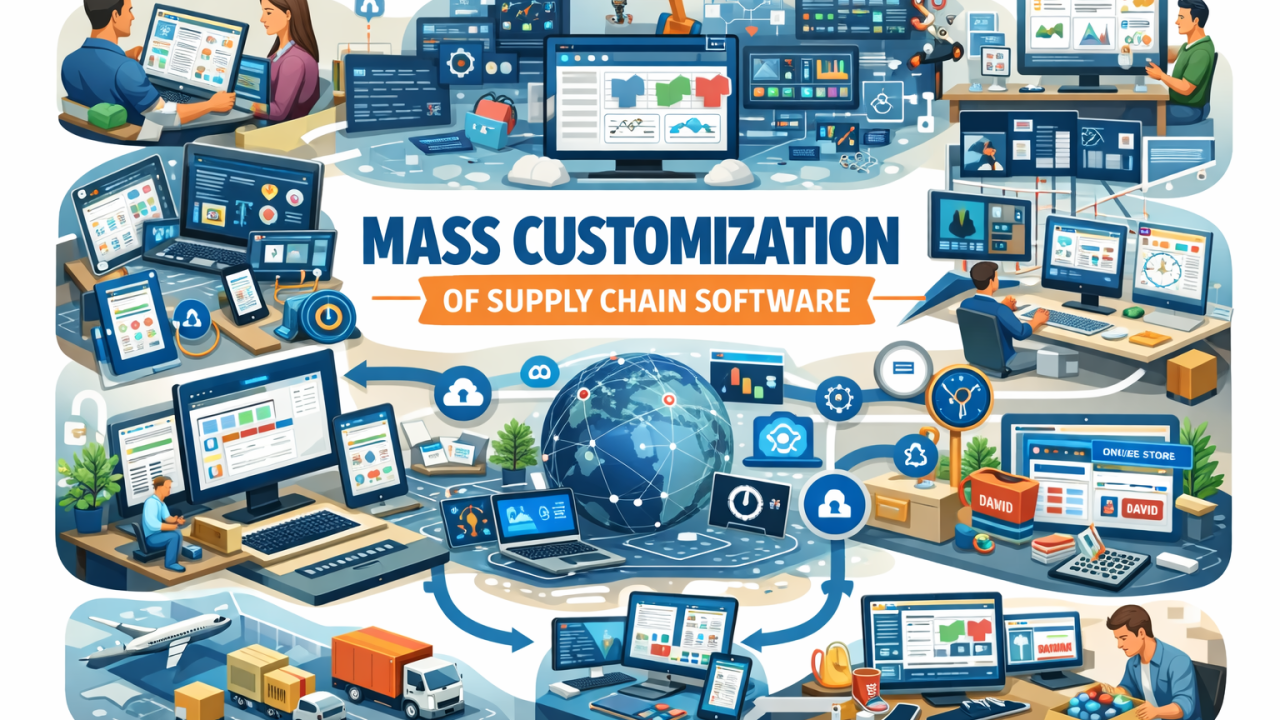
Mass Customization is Coming to Supply Chain Software - Sooner than You Think!

January 8, 2026

From the desk of Firstfshift CEO, Hari Menon:

Our team at Firstshift has been leveraging Claude Code for development and seeing great productivity gains. During the holiday break, I too tried my hand at developing a few mini applications using Claude Code (way different from when I last wrote production code!).

I was compelled to write this relatively long post (it was even longer before ChatGPT helped organize it and shorten it!) as I am now thoroughly convinced that supply chain software is about to change — fast.

We are nearing the end of the old customization trap.

The old world: “Customization” trap

In legacy supply chain platforms:

  • Customization = hard-coded logic
  • Every client variation forks the codebase
  • Upgrades become painful, slow, and risky
  • Innovation velocity drops as technical debt explodes

Most vendors know this story well. After a few years, customers end up locked into their version of the product.

The new world: Mass customization without fragmentation

With AI-assisted and agent-driven development:

  • Custom logic can be generated, tested, and isolated dynamically
  • Configurations become composable, not hard-wired
  • Upgrades are no longer blocked by client-specific logic
  • Enhancements can be rolled out across customers, not around them

This isn’t “one-off customization.”

It is mass customization with a single evolving core – a core of supply chain services (exposed as APIs) and a semantic context layer on top of which Agents are built.

Why this matters for supply chain

Supply chains are inherently heterogeneous:

  • Different networks
  • Different constraints
  • Different planning philosophies
  • Different data maturity levels

Trying to force this diversity into rigid templates never worked. But hard-coding every exception doesn’t scale either.

Agentic coding enables:

  • Planner-specific workflows
  • Industry-specific logic
  • Company-specific business rules and workflows without breaking the upgrade path

The real competitive advantage

The winners won’t just be companies that use AI in planning.

They’ll be the ones who :

  • Build software that adapts continuously
  • Treat customization as a runtime capability, not a consulting project
  • Deliver personalization at scale, without sacrificing maintainability

Supply chain software is moving from:

“Customize once, regret forever” to “Continuously adapt, continuously upgrade.”

That’s a structural shift — and Agentic AI is going to accelerate it.

Similar Blog Posts

News
May 5, 2026

Firstshift launches Supply Chain Canvas bringing the power of Agentic and Conversational AI to Supply Chain decision making

Newark, CA – May 5, 2026 — Firstshift today announced the launch of Supply Chain Canvas, an Agentic AI solution that enables supply chain teams to move from analysis to executable plan in minutes. Supply Chain Canvas introduces a fundamentally new way to interact with planning and execution systems. Instead of navigating dashboards, running reports and stitching together spreadsheets, planners can converse with Canvas in plain English to generate insights, run scenarios and generate forecasts and plans. 

“AI has great potential to significantly improve and transform how supply chains have operated for years. Most organizations are still running the same time consuming manual processes with slightly better forecasts and plans,” says Hari Menon, CEO of Firstshift. “Supply Chain Canvas closes that gap. It brings the intelligence people experience everyday through Large Language Models (LLMs) like Claude or GPT into the core of supply chain decision-making. What used to require weeks can now be completed in minutes.”

Supply Chain Canvas provides planners with a “single window” to generate insights, run scenarios and act. A planner describes a question, scenario or what-if in natural language. Supply Chain Canvas then queries the organization’s supply chain data, ingests relevant external signals, makes the right tool calls and runs in-memory simulations. Within seconds, the planner receives demand forecasts, supply plans, S&OP scenarios and financial impact analysis with no training required. Planners can also build agents that perform repeated tasks, workflows and generate insights.

By automating the data to action pipeline, Supply Chain Canvas shifts planning teams away from manual work and toward higher-value decision-making. Organizations can reduce planning effort by up to 80 percent while expanding each planner’s ability to manage more SKUs, locations, customers and scenarios. Instead of assembling data and building models, teams focus on exception management, cross-functional alignment and strategic decisions that impact service, cost and growth.

“Canvas gives planners the ability to make faster decisions. It makes them the strategists they were hired to be,” Menon says. “The goal is to enable more scenario analysis and better decisions at a faster pace than traditionally possible.”

Built on Firstshift’s evergreen cloud and AI-native platform, Supply Chain Canvas leverages a combination of proprietary models and Anthropic's next-generation Claude technology using large language models (LLMs) and AI assistants. Supply Chain Canvas deploys quickly and delivers immediate value without the burden of traditional implementations. Supply Chain Canvas is SOC-2 Type 2 and GDPR compliant, meeting the same security standards customers already trust from Firstshift.

Whether you're running a legacy planning system or a rigid enterprise platform, Supply Chain Canvas layers seamlessly on top, delivering the same level of intelligence without disrupting what's already in place. For companies already on the Firstshift platform, Supply Chain Canvas unlocks its full potential. Existing customers can go live in as little as two weeks with zero additional data migration. Companies interested in Supply Chain Canvas can request a live demo using their own data by visiting firstshift.ai

About Firstshift

Firstshift helps supply chain leaders plan smarter and act faster through an AI-native  supply chain planning and intelligence platform that delivers speed, impact and scale. Built to eliminate spreadsheets and replace legacy planning tools, Firstshift delivers AI powered advance planning capabilities at faster time to value and  lower TCO than legacy planning systems.

Insights
February 27, 2026

Solved: How an Industrial Distributor Scaled Planning Without Adding Headcount

Growth is supposed to be a good thing.

But for many Industrial Distributors, expansion quietly exposes structural cracks in their planning process. More SKUs. More customers. More locations. More variability. And yet, the same number of planners. At a certain point, proactive coordination breaks down and planning becomes a series of non-stop fire drills.

This scenario reflects the daily reality of mid-sized North American industrial distributors trying to scale their planning without scaling their headcount.

The Problem: Growth Outpaced Planning Capacity

Our featured distributor had grown significantly through both organic expansion and acquisitions, increasing their network to over 40 locations and their SKU count to over 100,000. Customer agreements got more complex. Lead times fluctuated. Supplier reliability was a constant variable.

The ERP system remained the operational backbone. It handled financials, orders, and inventory tracking. However, it was never designed to dynamically prioritize planning decisions across this massive network. To compensate, planners relied on spreadsheets stacked on top of ERP data. Exception lists grew longer, and manual overrides became the norm.

The team didn’t lack expertise; they lacked scalable decision support.

Why Planning Turns Into Fire Drills

As complexity increased, the planning cycle became reactive:

  • Expedites replaced structured replenishment.
  • Inventory imbalances spread across the network.
  • High-value and low-value SKUs consumed the same amount of planner attention.
  • Service issues were addressed after the fact instead of being anticipated.

Every day felt like a crisis. Every decision felt manual. Leadership’s predictable first instinct was to add headcount, but they realized this would only increase cost linearly with complexity and wouldn’t fix the core structural issue. Replacing the deeply integrated ERP was also not an option.

The Breaking Point: A crisis of decision latency

The tipping point arrived during a period of accelerated growth. Order volumes were up, but service levels dipped. Expedite costs rose. Inventory was growing in some warehouses while stockouts persisted in others.

Leadership correctly diagnosed the problem: it wasn't a lack of effort; it was decision latency.

The business needed to solve three things:

  1. Prioritize what actually mattered.
  2. Anticipate risk before service failed.
  3. Scale planning output without adding headcount.

The Solution: Scaling Intelligence, Not Labor

The organization reframed the problem. Instead of asking, “How do we hire more planners?” they asked, “How do we reduce unnecessary decisions and elevate the important ones?”

The ERP remained the system of record. They introduced a Planning Intelligence Layer above it to drastically improve prioritization and responsiveness.

  • AI-powered demand and replenishment models were deployed. Planners were no longer required to review every SKU. Instead, the system prompted them only when risk thresholds were crossed.
  • Inventory optimization logic aligned stocking policies with service objectives and working capital constraints.
  • Scenario modeling allowed the team to test supply disruptions or demand spikes before they occurred.

The result? The system narrowed the options, surfaced the critical trade-offs, and dramatically reduced the noise. Planners remained accountable, but their attention was focused on the highest-impact tasks.

Signals → Decisions → Outcomes

A framework for moving from fire drills to flow

This framework shifted the business from reactive firefighting to controlled flow.

Signals (What became visible sooner):

  • Emerging stockout risk by SKU and location.
  • Supplier variability affecting replenishment timing.
  • Imbalances between warehouses.
  • Demand shifts across customer segments.

Decisions (What planners focused on):

  • High-impact replenishment adjustments.
  • Inventory rebalancing across locations.
  • Policy changes tied to service tiers.
  • Proactive responses to supplier variability.

Outcomes (The operational change):

  • Fewer last-minute expedites.
  • More stable service levels.
  • Reduced working capital tied up in misaligned inventory.
  • Sustainable planner workloads despite continued growth.

The Results

Within months, the distributor achieved improved service consistency, reduced expedite frequency, and more balanced inventory positioning. The same team successfully managed a larger, more complex network with greater precision.

Planner burnout decreased. Crucially, growth no longer automatically triggered discussions about increasing the planning team's size.

The competitive advantage for industrial distributors is clear: it lies in scaling decision velocity without scaling headcount.

Fire drills feel productive. Flow is scalable.

Let's talk about how Fristshift can help you do the same thing in a matter of weeks.

___

This is the latest in our Solved: series, exploring how real-world supply chain planning problems can be addressed without replacing the systems that keep the business running.

Insights
February 24, 2026

AI Powered Demand Planning Forecasting: Elevating Planners, Not Replacing Them

Everyone is talking about autonomous supply chains. Self-driving forecasts. Lights-out planning. AI making decisions without human intervention.

It sounds efficient and advanced. It also misunderstands how real businesses operate.

In practice, accountability never disappears. The Chief Supply Chain Officer still owns service levels. The CFO still owns working capital. When the forecast misses, no one blames the algorithm.

They blame the business.

The real objective of AI Powered Demand Planning is not to remove humans. It is to elevate them by reducing the noise, compressing complexity, and accelerating confident decisions while keeping ownership exactly where it belongs.

Control is not the opposite of innovation. It is what makes innovation usable.

The False Choice:  Automation vs. Human Ownership

Many organizations feel stuck between two imperfect options:

  • Continue managing demand in spreadsheets where planners “own” the forecast but spend their time reconciling data
  • Rely on traditional planning platforms that generate outputs few people fully trust

Both approaches create friction.

Spreadsheets create fragility: forecast logic lives in individual files, version control breaks, or institutional knowledge sits with a handful of planners. When they leave, performance drops.

Legacy tools create rigidity: long implementations, heavy customization, or disruptive upgrades. Static optimization that stops improving after deployment.

AI-Powered Demand Planning changes the model. It does not automate judgment away. It scales it.

What is AI Powered Demand Planning?

AI delivers three capabilities consistently.

1. Narrow the Field of Decisions

Modern AI continuously senses demand shifts and surface material risks across SKUs, locations and time horizons.

Instead of forcing a single opaque answer, it:

  • Highlights demand trends and volatility
  • Quantifies service and inventory risk
  • Surfaces meaningful exceptions

Planners are prompted when action matters. They are not buried in dashboards.

AI becomes a filter for complexity, not a replacement for accountability.

2. Make Tradeoffs Explicit

Every planning decision carries tradeoffs:

  • Service versus working capital
  • Bias versus stockout risk
  • Fill rate versus margin

AI-Powered Demand Planning makes these tradeoffs transparent. It shows what changed, why it changed and what the downstream impact looks like before execution.

Explainability builds trust. Trust drives adoption. Adoption sustains ROI.

Without transparency, even the most advanced models stall in real-world use.

3. Embed Institutional Knowledge

In many companies, demand planning strength resides in individuals. The planner who understands which customer double-orders. The operator who knows when seasonal pull-forward is noise versus signal.

That knowledge must move from memory into workflow.

AI platforms that embed institutional logic into collaborative processes reduce dependency on individual heroics. They elevate planners by turning experience into repeatable intelligence.

The result is resilience without staff upheaval.

From Reactive Planning Cycles to Decision Readiness

Traditional demand planning operates in cycles: monthly consensus meetings, static forecast versions and post-mortems after service failures.

AI-Powered Demand Planning shifts the operating model toward continuous decision readiness.

Instead of reacting after impact hits revenue or inventory, planners are alerted when volatility crosses thresholds or when forecast deltas create material financial exposure.

This reduces decision latency across the organization.

  • Supply Chain planners gain earlier risk visibility
  • CFOs gain greater confidence in working capital projections
  • COOs gain faster pivot capability

The planner still owns the call. AI simply ensures they are ready to make it.

Beyond Spreadsheets and Legacy Platforms

For companies still running demand planning in spreadsheets, the risk is structural.

Forecast logic is fragmented. Scenario modeling is manual. Data reconciliation consumes time that should be spent on decision-making.

AI-Powered Demand Planning institutionalizes logic, automates sensing and reduces fragility without forcing ERP replacement or massive process redesign.

For organizations on traditional planning platforms, the challenge is different.

Many legacy systems:

  • Require long implementation cycles
  • Freeze innovation after go-live
  • Depend on costly upgrades and consulting cycles
  • Layer AI on top rather than embedding it natively

Modern, cloud-native platforms operate differently. They deploy in weeks, not years. They improve continuously without disruptive upgrades. They integrate with existing ERP systems while acting as the system of intelligence.

Most importantly, they keep planners accountable.

The goal is not “trust the machine.” It is “equip your team with machine speed.”

The Future of planning is Accountable Intelligence

The companies that win in demand planning will not be those chasing fully autonomous supply chains.

They will be the ones that:

  • Reduce decision latency without reducing ownership
  • Scale intelligence across growing complexity
  • See measurable impact quickly rather than waiting years for ROI
  • Allow innovation to compound over time rather than reset with every upgrade

Architecture matters.

If value is trapped behind long implementations and disruptive replatforming, momentum stalls. If AI operates as a black box, adoption erodes. If total cost grows linearly with complexity, planning becomes a burden instead of a lever. AI-Powered Demand Planning elevates planners and improves economics simultaneously.

If you are evaluating how to modernize demand planning without surrendering ownership or locking into another legacy cycle then schedule a demo with Firstshift. See how AI-Powered Demand Planning can elevate your planners, accelerate time-to-value and deliver measurable impact without forcing disruption. In our case study, Blue Diamond Growers credits Firstshift and our demand sensing solution as instrumental in enabling them to gain real-time visibility into demand signals across their supply chain.

Stay Ahead with Firstshift Insights

Keep your finger on the pulse of supply chain innovation with the Firstshift newsletter.
By subscribing, you agree to our Privacy Policy and consent to receive updates from us.
Thank you! Your submission has been received!
Oops! Something went wrong while submitting the form.